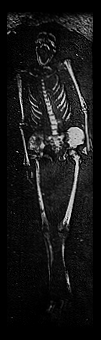
It would be impossible to provide a complete list of all the cases of vampirism - investigated or merely suspected - this represents a small cross-section of events thoughout history.
|
|
France (1310)
Following the Council of Troyes in May, King Phillippe ordered that
the corpse of a certain Jehan de Turo be exhumed and destroyed by
fire 'on suspicion that he was a Vampyre'. Jehan was said to have
been foreman of the Tower and an initiate of the Temple who had died
a century earlier.
Bohemia (1337)
Reports indicate that several Vampires manifested themselves at this
time from the cloisters of the church at Opatowicze, but the
disturbances ceased after the area was exorcised with holy water and
a silver cross hung on the wall. Also in Bohemia, at the town of
Lewin, a woman called Brodka, who was believed to dabble in sorcery
and had died by her own hand, was buried at the local crossroads in
1345. Suicides of evil repute who were not interred in this manner
were believed to become Vampires after death.
Upper Styria (1451)
At Gratz in the mountainous regions of upper Styria, now a Province
of Austria, lived Barbara de Cilly, a beautiful woman much loved by
Sigismund of Hungary. When close to death, she was apparently saved
by the use of a secret ritual devised by Abramerlin the Mage, but as
a result was condemned forever after to be a Vampire. This woman was
the inspiration for Camilla, the
masterpiece about a female vampire by the Irish writer, Joseph
Sheridan Le Fanu.
Turkey (1523)
A Vampire which had been terrorising
the people of Sjonica was finally driven away by a courageous man
named Ibro who attacked the creature one night with a knife upon
which was engraved a lucky symbol to ward off evil spirits. Although
the creature fled, never to be seen again, a spot of its blood left
behind on the ground proved impossible to remove.
Moravia
(1617)
A beautiful and allegedly very beguiling female Vampire seduced and
then drank the blood of a number of men in the town of Craiova during
this year. She was last seen near the River Jiu and, as water is said
to be fatal to Vampires, is presumed to have drowned.
Hungary (c. 1690 -
1725)
For some years, Arnold Paul, the High Duke of Medreiga, was said to
have been regularly attacked by a Vampire at Cassova - but then
claimed to have put a stop to these attacks by eating earth taken
from the dead man's grave and also smearing himself with the dead
creatures blood which he found in the tomb. However, soon afterwards,
the High Duke died in an accident. and within weeks cases of
vampirism were being reported throughout the region. Though the
Duke's body was exhumed and destroyed, the phenomena continued and
records claim that Arnold Paul turned a total of 17 others into
Vampires.
Serbia
(1725)
A vivid account of a plague of Vampires which troubled districts of
Serbia for almost a decade has been described by John Heinrich
Zopfius in a dissertation published in 1734: "The vampyres, which
came out of the grave in the night-time, rushed upon people sleeping
in their beds, sucked out all their blood, and destroyed them. They
attacked men, women and children; sparing neither age nor sex. The
people attacked by them complained of suffocation, and a great
interception of spirits; after which, they soon expired. When these
Vampyres were dug out of the graves, they appeared in all parts, such
as the nostrils, cheeks, breasts, mouth, etc, turgid and full of
blood. Their countenances were fresh and ruddy; and their nails, as
well as their hair, very much grown. And, though they had been much
longer dead than many other bodies, which were perfectly putrified,
not the least mark of corruption was visible upon them. Those who
were destroyed by them, after their death, became Vampyres; so that,
to prevent so spreading an evil, it was found requisite to drive a
stake through the dead body from whence, on this occasion, the blood
flowed as if the person was alive. Sometimes the body was dug out of
the grave, and burnt to ashes; upon which, all the disturbances
ceased."
Miravia (1731)
Two women, an old crone named Miliza and a young beauty, Stanno, both
of whom had died in 1729, were to be the cause of an outbreak of
vampirism at Metwett. Thirteen deaths occured in a two-week period in
this area, which were attributed to the couple, Miliza was said to
have become a vampire as a result of having sexual intercourse with a
male member of the undead in Turkey before she moved to Moravia, and
it was there that she infected her young confederate.
Yugaslavia
(1816)
While the famous French author, Prosper Merimee, was dining with some
friend at Varbeska, a vampire appeared at an upstairs window in the
house and bit the neck of a young girl named Khava who was sleeping.
According to Merimee, the girl awoke just as the creature was raising
himself up from her bed and, despite her fear, she recognised him as
a man named Vieczany who had died a year defore. At this, the family
and some friends lit torches and went to the village cemetery where
the man was buried. Vieczany's coffin was opened and his body was
found to be untouched. Although the Vampire was destroyed, his victim
passed away 18 days later.
America (1845)
According to a report in the Norwich Courier in Connecticut, after
the death of a certain Horace Ray in Jewett City in the winter of
1845, the members of his family all fell ill of a wasting desease.
When just one son remained alive, the body of the father was exhumed
and found to be as fresh as the day it had been laid to rest. After
the corpse had been burned, the health of the last members of the Ray
family reapidly inproved and he lived to a ripe old age convinced
that his parent had been a Vampire.
Great Britain (1889)
A grisly-looking Vampire plagued the Cranswell family living in
isolated Croglin Grange in Cumberland. The creature repeatedly tried
to break into the manor house and attack the beautiful young
daughter, Anne. When finally tracked to its lair in a nearby
churchyard by the girl's two brothers, the Vampire's coffin was set
on fire and its body consumed n the flames.
Rumania (1889)
One of the worst outbreaks of vampirism on record occurred in the
district of Crassova when several dozen mwn, women and children were
discovered to be slowly dying from blood loss and bite marks on their
necks. In a concerted effort by the local people, a total of 30
corpes were interred in local graveyards and all pierced by stakes,
before the attacks ceased. In Rumania, also, a few years later, the
youngest-ever Vampire was reported - a 13-year-old child who had
recently died and was reportedly attacking other infants while they
slept. The villagers of Prejam, in the Vilcea district, provided
their own solution by staking the child in its coffin and then
removing the head.
Transylvania (1905)
When an old gypsy in Capatineni, near Arges, where Vlad Dracula had
once lived, it was noticed that no signs of rigor mortis developed
while the body was on view to relatives and friends. When the corpes
still remained supple after several days, it was decided the man had
become a Vampire and his heart was pierced by a stake before the
burial.
America (1996)
Richard Wendorf and his wife Ruth of Eustis,
Florida, were murdered on November 25, 1996, victims of what was
termed a Vampire cult murder in the press. Three days after the
murder, 16-year-old Roderick Ferrell of Murrey, Kentuckey, and four
other teenagers were arrested. As the story of the case unfolded, it
tied the group to the popular role-playing game: Vampire: The Masquerade. A large group in Murrey played the game in which
they assumed the role of Vampire characters and developed their parts
in what was an ongoing Vampire drama.
Reportedly, Ferrell became caught up in the imaginary world of the
game and became the leader of a small group within the larger
membership of friends. His more serious approach to the fantasy world
led to the disruption of the group, and Ferrell's own break with a
close friend who had introduced him to the game.
Ferrell, it seems began to live out his Vampire character. He dressed
in black and dyed his hair to match. He began using his Vampire name,
Vessago, all the time. After being suspended from school in September
1996, he started a nocturnal life, and the group that hung out with
him took on some religous-like trappings of a cult-like nature. They
took very seriously the embrace, a term used in the game to describe
the transformation of someone into a Vampire. In Ferrell's group, the
embrace was not merely symbolic, but actually involved the sharing of
blood between group members.
On several occasions during 1996, Ferrell, who previously had lived
in Florida, returned there to visit his former girlfriend, Heather
Wendorf. Heather joined Ferrell in some blood drinking and later
reported that she believed herself to have comuned with spirits
during the blood drinking rituals. Then in November 1996, Ferrell and
three members of his Murray group headed for Florida, where, after
meeting Heather on the afternoon of November 25, they performed a
blood-sharing ritual to embrace Heather into her new Vampire life. It
was a short time after that ritual that Ferrell led in the blugeoning
to death of her parents. A V sign surrounded by
circular marks was burned into her fathers body. The group, including
Heather, fled to Louisiana where they where arrested on Thanksgiving
Day.
Following Ferrell's arrest, the press briefly questioned the role of
Vampire: The
Masquerade in the crime, but soon
concluded, as in the case of several suicides among players of
Dungeons and Dragons, that the game did not act as a causative factor
in the teenagers' actions. The game may have supplied Ferrell with
content for his imaginary world, but had it not been present, some
other fantasy would have been created as a vehicle for his
sociopathology.
Ferrell's trial occured in February 1998. He was charged with murder
and the three who came to from Kentucky with him with lesser charges.
Heather Wendorf was not charged and served as a major witness.
Ferrell pleased guilty, he was sentenced to the electric chair.
Further
information on Rod Ferrell