
|
Elizabeth Bathory (1560 - 1614) AKA. Female Dracula |
|
|
Elizabeth Bathory was the countess who tortured and murdered numerous young women and, becouse of these acts, became known as one of the true Vampires in history. She was born in 1560, the daughter of George and Anne Bathory. Though frequently cited as Hungarian, due in large part to the shifting borders of the Hungarian Empire, she was in fact more closely associated with what is now the Slovik republic. Most of her adult life was spent at Castle Cachtrice, near the town of Vishine, northwest of present-day Bratslava, where Austria, Hungrey, and the Slovak Republic come together. Bathory grew up in an era when much of Hungary had been overrun by the Turkish forces of the Ottoman Empire and was a battleground between Turkish and Austrian armies. The area was also split by religious differences. Her family sided with the new wave of Protestantism that opposed the traditional Roman Catholicism. She was raised on the Bathory family estate at Ecsed in transylvania. As a child As a child she was subject to seizures accompanied by intense rage and uncontrollable behavior. In 1571, her cousin Stephan became prince of Transylvania and, later in the decade, additionay assumed the throne of Poland. |
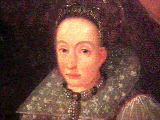 Bathory |
|
In a time when cruel and arbitrary behavior by those in power toward those who where servents was common, Elizabeth's level of crualty was noteworthy. She did not just punish infringements on her rules, but found excuses to inflict punishments and delited in the torture and death of her victims far beyond what her contempories could accept. She would stick pins in various vixtims body parts, such as under the fingernails. in the winter she would execute victims by having them stripped, led out into the snow, and doused with water until they were frozen. |
|
As early as the summer of 1610, an initial inquiry had begun into Elizabeth's crimes. Underlying the inquiry, quite apart from the steadily increasing number of victims, were political concerns. The crown hoped to confiscate Elizabeth's large land holdings and escape having to pay back the extensive loan that her husband had made to the king. With these things in mind, Elizabeth was arrested on December 29, 1610. Elizabet was placed on trial a few days later. It was conducted by Count Thurzo as an agent to the King. As noted, the trial was initiated to not only obtain a conviction, but to also confiscate her land. A week after the first trial, a second trial was convened on January 7, 1611. At this trial, a register found in Elizabeth's living quarters was introduced as evidence. It noted the names of 650 victims, all recorded in her handwriting, her accomplices were sentenced to death, the manor determined by their roles in the the tortures. Elizabeth was sentenced to life imprisonment in solitary confinement. She was placed in a room in her castle at Cachtrice without windows or doors and only a small opening for food and a few openings for air. There she remained for the next three years until her death on August 21, 1614. She was buried in the Bathory land at Ecsed. Above and beyond Bathory's reputation as a sadistic killer with more than 600 victims, she has been accused of being both a Werewolf and a Vampire. During her trials, testimony was presented that on occasion, she bit the flesh of the girls while tortuing them. These accusations became the basis of her connection with Werewolfism. The connection between Elizabeth and vampirism is somewhat more tenuous. Of course, it was a popular belief in Slavic lands that people were Werewolves in life became Vampires in death, but that was not the accusation leveled at Elizabeth. Rather, she was accused of draining the blood of her victims and bathing in it to retain her youthful beauty, and she was by all accounts a most attractive woman. |